Navigation überspringen
  • milestones

20 years of tourism with Salzburg AG: Between Diesel, Steam & Grand Visions

Twenty years of tourism with Salzburg AG - a journey through time


Twenty years of tourism with Salzburg AG – along with countless stories. Since the SchafbergBahn cog railway and WolfgangseeSchifffahrt ferries were taken over in 2006, a great deal has changed. New experiences have been created, the "5 Treasures" were born, historic infrastructure has been modernized, and the ExperienceQuarter has opened a new chapter of its own. Together with Martin Bahr, Department Lead Salzkammergut (SchafbergBahn and WolfgangseeSchifffahrt), we look back on two decades of milestones, memorable moments, and personal recollections.


2006: A New Beginning Full of Optimism

Martin Bahr, Department Lead Salzkammergut (SchafbergBahn and WolfgangseeSchifffahrt)

When Salzburg AG took over the SchafbergBahn and WolfgangseeSchifffahrt from Austrian Railways on March 31, 2006, a new chapter began for two of Austria's best-known tourist attractions. Just a few weeks later, the first season under the new management got underway – with the clear goal of preserving what had proven successful while introducing new ideas. Passenger numbers rose significantly during that very first season. From the outset, investments were made in infrastructure, service quality, and new visitor experiences. The employees could also sense that this was the right direction, even if not everyone knew what the future would bring. "I personally had a pretty good feeling about it back then – otherwise I wouldn't have stayed. But there was definitely a certain level of uncertainty amongst the team. Nobody really knew what lay ahead," recalls Martin Bahr, who had already been working for the SchafbergBahn before the takeover by Salzburg AG twenty years ago.

When Train and Ship Became a Holiday Experience

The takeover also changed the way tourist attractions were viewed. The railway and the boats were no longer to be seen simply as a means of transportation, but rather as year-round excursion destinations offering special experiences  in their own right. Breakfast excursions on the Schafberg, romantic sunset cruises, and attractive package deals including Hotel Schafbergspitze helped extend the season significantly. One idea, in particular, turned into a real success story. "Our Advent program developed incredibly well. We simply said, 'Let's give it a try.' To this day, it is one of our most successful offerings," Martin Bahr says. Just how quickly the Advent cruises established themselves is illustrated by one story he still remembers today. "One day there were so many people on the boats that we didn't even have time to collect the fares. Our manager at the time simply got into his car, drove to Strobl, and sold the tickets there." What began as an experiment back then has since become one of Salzburg AG Tourismus' most popular attractions.

Historic Railway Meets Modern Technology

The decorated VZ31 on the occasion of the SchafbergBahn’s 120th anniversary in 2013

On the Schafberg, tradition and innovation are not mutually exclusive – far from it. To ensure that the historic railway could keep pace with steadily growing visitor numbers, the infrastructure was modernized step by step. In 2010, the VZ 31 became the first diesel-electric locomotive to enter permanent service on the SchafbergBahn. Six years later, it was joined by the VZ 32. Not every innovation, however, was immediately welcomed with enthusiasm. "The first reaction was generally skepticism. But eventually everyone realized that trying something new wasn't such a bad idea after all," Martin Bahr says with a kind smile. Today, the modern diesel-electric locomotives complement the oil-fired steam engines perfectly, together ensuring reliable and attractive operations on this iconic cog railway.

The Biggest Construction Project in the History of the SchafbergBahn

The start of the track renovation in 2018

One particularly impressive milestone was the comprehensive renewal of the railway line, which began in 2018. At that time, parts of the infrastructure actually dated back to the original construction of the SchafbergBahn. "When I first came to the SchafbergBahn, we still had some sections of track that were laid when the cog railway was established. Some of the switches still bore the year 1892," Martin Bahr recalls. Collaboratively, the provinces of Salzburg and Upper Austria along with Salzburg AG invested more than €18 million in modernization of the line. The tracks, track bed, utility lines, and technical systems were updated, laying a solid foundation for the future. One particular challenge was the logistics involved. "The biggest uncertainty in the mountains is always the weather. And almost everything needed for the construction work has to be transported up the mountain by train. That makes a project like this especially demanding," says the experienced railway man. For him, renewal of the line remains one of the most important projects of the past two decades.

Anniversaries, Records & Memorable Moments

Whether the 115th anniversary of the SchafbergBahn and the 135th anniversary of the WolfgangseeSchifffahrt in 2008, or the big anniversaries celebrated in 2023, the past twenty years have repeatedly brought special highlight moments. Above all, the first major anniversary under Salzburg AG remains vivid in Martin Bahr's memory. "That was when the Emperor's Coach, the paddle steamer, and many historic vehicles were restored. As a young operations supervisor, that was something very special for me." The years that followed brought record-breaking visitor numbers, the challenges of the COVID-19 pandemic, and ultimately an impressive comeback. Throughout it all, the story of the cog railway and the ferries was never simply preserved – new chapters continued to be written.


Numbers that speak for themselves

From the time Salzburg AG took over the tourism division in 2006 through the end of August 2026, approximately 15 million passengers were transported by boat and train in the Salzkammergut region. During this period, the SchafbergBahn covered about 705,000 kilometers, and WolfgangseeSchifffahrt covered an impressive 1.275 million kilometers. Together, this amounts to just under 2 million kilometers—a distance equivalent to nearly 50 trips around the Earth.

From Two Attractions to 5 Treasures

What began in 2006 with the SchafbergBahn and WolfgangseeSchifffahrt gradually evolved into a diverse tourism offering. The historic FestungsBahn funicular, the Mönchsberg lift, and the WasserSpiegel museum were added in subsequent years, and today the five attractions are united under the "5 Treasures" brand. With the establishment of Salzburg AG Tourismus Management GmbH in 2019, all of Salzburg AG's tourism activities were brought together under one organizational roof. Since then, the 5 Treasures have stood for memorable experiences – extending from the summit of the Schafberg and cruises on Lake Wolfgang to the famous landmarks of historic Salzburg City and fascinating insights into the world of water.

Experience the 5 Treasures

  • SchafbergBahn: Ride Austria's steepest cog railway to the 1,783-meter (5,850-foot) summit of the Schafberg for an unforgettable experience the whole family is sure to enjoy.
  • WolfgangseeSchifffahrt: A cruise across Lake Wolfgang not only interconnects the lakeside villages of St. Gilgen, Strobl, and St. Wolfgang – it also offers the pure pleasure of slowing down the pace of life.
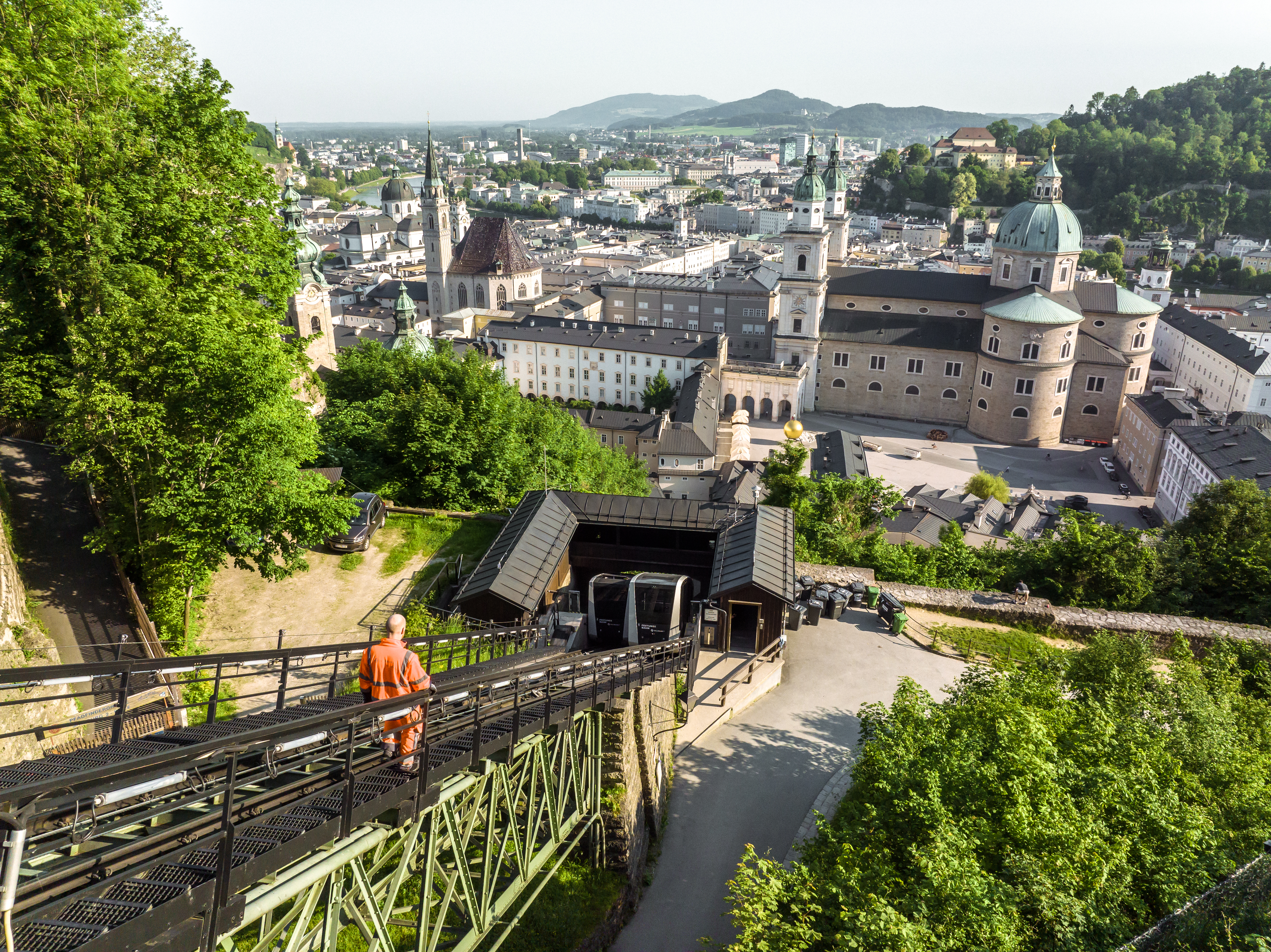
  • FestungsBahn: Austria's oldest funicular railway carries visitors up to Hohensalzburg Fortress, Salzburg's iconic landmark. Aside from a journey back to the Middle Ages, visitors are rewarded with spectacular views across the city's rooftops.
  • MönchsbergAufzug: In just a few seconds, the Mönchsberg lift carries visitors from the bustling historic district of Salzburg up to the peaceful natural setting of the Mönchsberg.
  • WasserSpiegel: At the interactive WasserSpiegel Museum, school groups discover how Salzburg has managed to supply itself with high-quality drinking water for centuries.

From Railway Station to ExperienceQuarter

Salzburg AG Abriss Talstation der Schafbeergbahn in St. Wolfgang Foto: Neumayr/Leo 11.03.2021
Demolition of the old valley station in March 2021

Few projects symbolize the transformations of the past twenty years as clearly as the ExperienceQuarter in St. Wolfgang. By 2023, the aging valley station had been transformed into a modern visitor center with restaurants, a shop, and event spaces. In 2024, it was even awarded the Prix Versailles as the World's Most Beautiful Railway Station. For Martin Bahr, however, saying goodbye to the old valley station was far from a melancholy moment. "When the old valley station was demolished, I didn't feel any sadness. I was excited about what was coming next. It had simply become too cramped and no longer met today's needs." Even though carrying out the construction work while maintaining normal operations was an enormous challenge, he believes the courage to embrace change has paid off. "At first, many people were skeptical. Today, many of them say the building blends into the landscape wonderfully."

Ready for the Next 20 Years

Schiff der WolfgangseeSchifffahrt, die größte Binnenseeflotte Österreichs, und blühende Kirschblüten am Ufer des Wolfgangsees in Sankt Wolfgang am Wolfgangsee im Frühling am 17.04.2025. // A ship of the WolfgangseeSchifffahrt, Austria's largest inland lake fleet, and blooming cherry blossoms on the shore of Lake Wolfgang in Sankt Wolfgang am Wolfgangsee in spring on April 17, 2025.
Ready for the next 20 years filled with moving history, impressive technology, and unique views

Today, the 5 Treasures encompass five very different destinations, but they all have one thing in common. They offer memorable experiences that combine nature, technology, culture, and history in a unique way. The SchafbergBahn and WolfgangseeSchifffahrt alone welcome around one million passengers every year. Standing still, however, has never been an option. Ongoing investment in infrastructure, digitalization, and sustainability – including the use of climate-friendly HVO fuel – is intended to ensure that the success story continues. For Martin Bahr, that is precisely the secret of the past twenty years. "We've continued investing, modernizing, and reinvesting what we've earned back into the operation. You could always tell that the goal was to keep moving forward." And when he looks back on his twenty years with Salzburg AG Tourismus, one thought stands out above all: "For me, the past twenty years have been an incredibly wonderful time. And I hope the next twenty will be just the same."


You might also like

The Sound of Music and the five treasures: highlights The Sound of Music and the five treasures: In the Footsteps of a Film Classic Few other films have shaped the world’s image of Salzburg quite like The Sound of Music. More than 60 years after its premiere, it still draws hundreds of thousands of visitors from around the world to the city of Mozart and the Salzkammergut every year, eager to experience the original locations of the Hollywood classic for themselves. Many of these places have one thing in common: They are found where the five treasures of Salzburg AG Tourismus GmbH continue to take guests to some of the most beautiful views, historic landmarks and unforgettable natural attractions in the region. Stories from Lake Wolfgangsee: history Stories from Lake Wolfgangsee: Summer Getaways, Sensations & Curious Tales Anyone wanting to discover the history – and the tales – of Wolfgangsee is in the best of hands with Augustin Kloiber, the town historian of St. Gilgen. Visitors have to climb to the attic of the village's former schoolhouse to meet him. On the way up, the old wooden floor creaks with every step you take, giving you a clear sense of what it must have sounded like here whenever generations of schoolchildren ran across those same floorboards once the bell rang for recess. In 30 seconds through the history of Salzburg: history In 30 seconds through the history of Salzburg: The MönchsbergAufzug lift The MönchsbergAufzug lift is one of the “Five Treasures” of Salzburg AG Tourismus GmbH – and far more than simply the quickest way up the Mönchsberg. Since 1890, it has connected Salzburg’s Old Town with a place where nature, architecture, culture and the city’s history come together in a unique way. A ride lasting just 30 seconds takes passengers through more than 135 years of history. When Muscle Power Makes Waves: highlights When Muscle Power Makes Waves: World Record on Lake Wolfgangsee The waters of Lake Wolfgangsee lie calm. The evening sun is reflected upon the water. But then the tension begins to build. Hundreds of eyes are fixed on two boats – members of the WolfgangseeSchifffahrt fleet. Between them: one man, one rope – and a moment that will be remembered. When – on May 13, 2026 – Franz Müllner succeeds in setting the two passenger vessels in motion using nothing but his own muscle power, a murmur runs through the crowd. A few seconds later, it’s clear: the Salzburg strongman has done it – he’s set a new world record! Between Schafberg and Lake Wolfgangsee: people Between Schafberg and Lake Wolfgangsee: Where Dream Jobs are found When Erik Haas drives to work in the morning, it takes him just a few minutes to get there. No traffic. No stress. Instead: mountains, the lake, and a workplace many people marvel at enviously. "They often tell us, 'You have such a great job in such a beautiful spot,'" the captain and locomotive engineer says with a laugh. And they're right. Anyone who works between the Schafberg and Lake Wolfgang gets to experience, every single day, a setting that most people only know from their vacations. Behind the scenes of the FestungsBahn: technology Behind the scenes of the FestungsBahn: The overhaul of a historic funicular Every year, the FestungsBahn funicular carries around 2.3 million passengers up to Hohensalzburg Fortress - arguably Salzburg's best-known tourism attraction – in just under a minute. To ensure that every ride is safe and runs smoothly, a precisely coordinated interplay of technology, experienced personnel, and regular inspections takes place behind the scenes. Gabriel Schmalzl, Operations Manager for the FestungsBahn, offers us insights into an area that remains invisible to most visitors, yet is all the more important, and explains what is involved in the general inspection process.